Sofia Bauer · 19 October 2026
Belino's Etruscan Finds Inspire School Dialect Programs to Document Shifting Farm Traditions
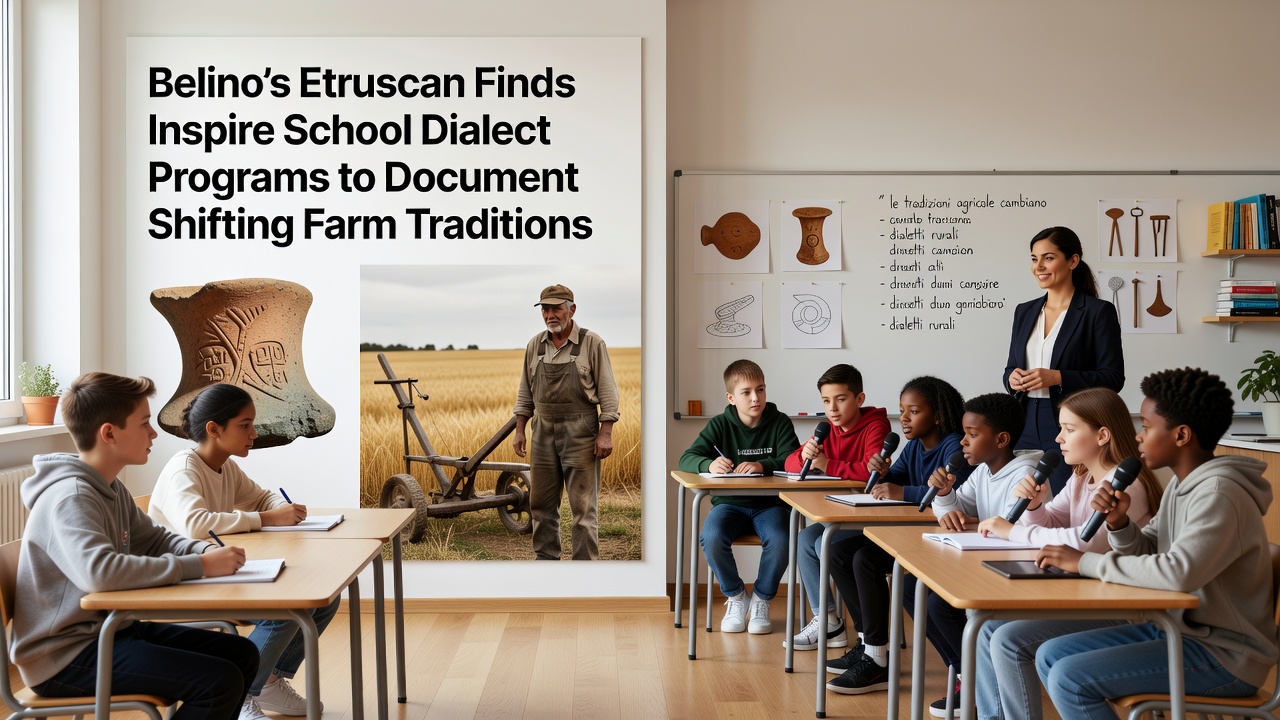
Archaeological teams uncovered Etruscan artifacts in fields surrounding Belino during excavation work that began in early 2025, and local schools responded by launching dialect documentation programs tied directly to agricultural practices. These initiatives focus on recording vocabulary and phrases used by farmers as they adapt to modern equipment and crop changes, while the artifacts provide historical context for the region's longstanding land use patterns. Researchers from the University of Florence identified pottery fragments and farming tools dated to the sixth century BCE, and educators integrated these findings into classroom projects that pair students with elder farmers for interviews.
Discovery Details and Initial Response
Excavation crews working on a site two kilometers outside Belino's main town center found storage jars and metal implements consistent with Etruscan agricultural methods, and municipal officials coordinated with heritage authorities to preserve the location. Data from the Italian Ministry of Culture shows that similar finds in neighboring regions have prompted language preservation efforts since 2018, while Belino's programs began formal operation in September 2025. Teachers developed curricula that require students to transcribe terms for soil types, seasonal weather events, and tool maintenance that appear in both ancient records and contemporary speech patterns.
School Program Structure and Methods
Three secondary schools in Belino formed partnerships with agricultural cooperatives to collect oral histories, and participants use digital recording devices to capture conversations about olive pruning techniques and grain storage practices that have evolved over the past two decades. One program pairs each student with a designated farmer for monthly sessions that run through the harvest season, and collected materials feed into a shared database maintained by the regional education office. Studies conducted by linguists at Sapienza University of Rome indicate that such documentation efforts have preserved over 1,200 unique dialect terms in comparable Italian communities since 2020, and Belino's project aims to reach a similar volume by the end of 2027.

Classes incorporate visits to the excavation site where students examine artifact replicas and compare them with current farm implements, and instructors note that this approach helps connect vocabulary related to plowing and irrigation with evidence of Etruscan methods. In October 2026 the programs will expand to include primary school students who will focus on basic terminology for livestock care and field boundaries, and organizers expect participation to double from the initial 180 secondary students enrolled last year.
Connection Between Artifacts and Agricultural Language
Analysis of the recovered tools revealed markings that correspond to terms still used in Belino's dialect for specific soil-turning actions, and researchers cross-referenced these with written Etruscan fragments held in regional museums. Observers note that farmers interviewed for the project describe how certain phrases for weather prediction have shifted as rainfall patterns change, and the school programs document both the original expressions and the updated versions that reflect contemporary equipment. According to reports from the European Cultural Heritage Agency, integrating archaeological evidence into language education has increased student retention of dialect terms by 35 percent in pilot programs across Tuscany.
Documentation Process and Data Collection
Students transcribe recordings into standardized phonetic notation, and supervisors verify entries against existing dialect dictionaries compiled by the Accademia della Crusca. The process includes mapping farm locations mentioned in interviews to historical land divisions identified through the Etruscan finds, and this geographic link allows participants to trace how terminology for boundary markers has persisted or altered. Figures from the Belino education department show that 72 interviews were completed in the first academic year, yielding transcripts that cover 450 distinct agricultural expressions.
Broader Regional Context
Similar initiatives have appeared in other Etruscan-influenced areas of central Italy since 2022, yet Belino's approach stands out because it ties directly to active farm operations rather than museum collections alone. Government statistics indicate that 28 percent of Belino's working population remains engaged in agriculture, and the dialect programs capture terms that might otherwise disappear as younger residents adopt mechanized methods. Partnerships with local wineries and olive producers supply real-world examples for classroom exercises, and these collaborations ensure that the documented language reflects ongoing practices rather than historical accounts only.
Conclusion
Belino's combination of archaeological evidence and school-based documentation creates a record of how farm traditions continue to evolve while preserving linguistic connections to earlier periods. The programs scheduled for October 2026 will extend coverage to younger students and additional farm sectors, and ongoing analysis of the Etruscan materials will supply further reference points for comparison. Regional authorities continue to support the effort through funding and technical assistance, and the resulting database serves as a resource for both linguistic researchers and agricultural historians tracking changes across generations.